

Research News – Institute of Child Nutrition
The Applied Research Division of the Institute of Child Nutrition (ICN) recently developed a research based resource to assist school nutrition (SN) professionals in identifying and utilizing 12 standard SN Key Performance indicators for managing and evaluating the following areas of their programs:
- Meal Counts and Participation
- Financial and Inventory Management
- Productivity and Labor
The resource title is Key Performance Indicators for Success. A hyperlink for this resource on ICN’s website is: https://theicn.org/documentlibraryfiles/PDF/20170329015554.pdf
 The Institute is in the process of developing a set of Excel Spreadsheets that will assist SN professionals in calculating and tracking each KPI in the resource for a 12 month period. We hope to have these finished and available on our website by Spring of 2018.
We are very proud of this resource, which will be valuable for anyone tasked with managing or evaluating any business aspect of a SN program.
Another valuable resource developed by ARD is Competencies, Knowledge, and Skills for Child Care Providers in CACFP Operations. While the Institute of Child Nutrition (ICN) ARD has been on the forefront of conducting research to address competencies, knowledge, and skills for child nutrition professionals at the local and state level, this resource is the first one at ICN to address Child and Adult Care Food Program (CACFP) professionals. The Competencies, Knowledge, and Skills for Child Care Providers in CACFP Operations resource focuses on the six identified functional areas and the competencies, knowledge, and skills associated with each functional area that are needed for child care providers to effectively work within a CACFP operation. The functional areas include:
- Administration
- Procurement
- Compliance
- Health and Safety
- Nutrition and Meal Management
- Education and Training
The Competencies, Knowledge, and Skills for Child Care Providers in CACFP Operations resource can be found on ICN’s website at https://theicn.org/documentlibraryfiles/PDF/20160323095712.pdf .
Expert Panel Meeting at ARD
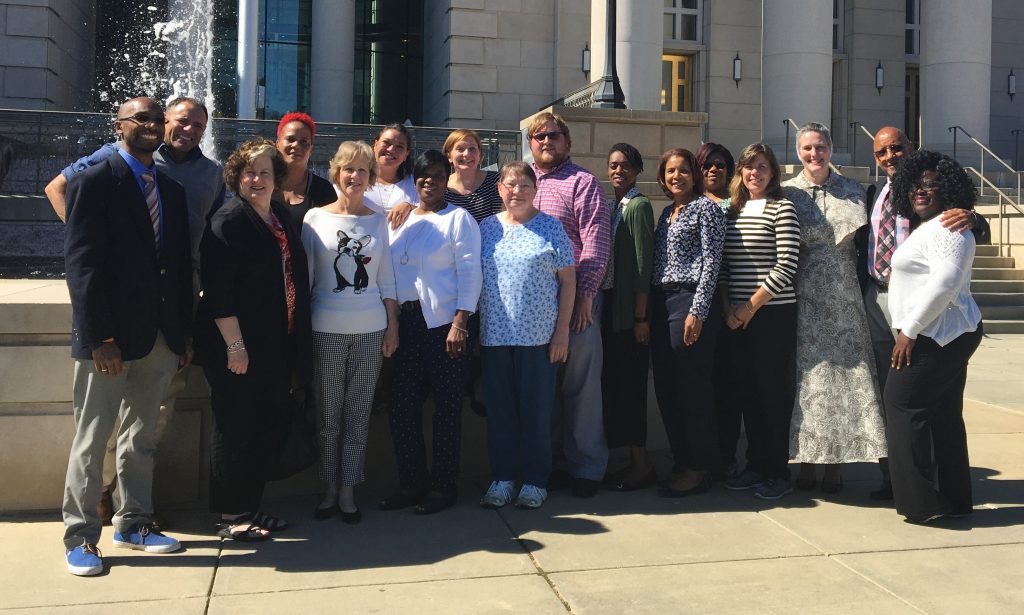
On October 17-18, 2017, key school nutrition (SN) stakeholders met at the University of Southern Mississippi in Hattiesburg, MS to participate in an expert work group to evaluate competencies, knowledge and skills needed for SN managers. This group of 12 individuals represented state agency personnel, SN directors, SN managers, SN manager trainers, SN supervisors, and researchers from across the seven USDA regions. The involvement of these stakeholders in the applied research process with the Applied Research Division of ICN is pivotal for successful development of Competency, Knowledge and Skills for the SN manager’s resource.
Staff Spotlight – Beverly Cross – Institute of Child Nutrition

Beverly Cross
Almost exactly 27 years ago, just as the National Food Service Management Institute was established, Beverly Pittman Cross began her dedicated career at what is now known as the Institute of Child Nutrition (ICN). She has contributed to growth, seen and affected change, mentored staff, worked under 8 Executive Directors, Interims, and Acting Executive Directors, traveled the country, met countless industry professionals, and contributed to the success of ICN as a vital member of the team. She was here when the Institute was established, attended the groundbreaking ceremony for the current building, participated in the 25th anniversary celebration, and saw the renaming and rebranding from NFSMI to ICN in 2015.
Beverly has too many stories to fit in one article, so we asked for a couple of her favorites. One fond memory she recounted is a conference for Special Needs Nutrition Management conducted at the Westin Hotel in Kansas City in October 1992. She was tasked with coordinating the conference, recruiting 24 leading authorities in nutrition and disabilities, planning logistics for 125 attendees from around the country, seated dinners, and other responsibilities. The event also included an appearance by U.S. Senator Bob Dole who was dedicated to the cause of providing full access in school nutrition programs to all children with disabilities. She recalls that due to limited funding, fall decorations and table centerpieces were made here in Oxford by NFSMI staff and North Mississippi Regional Center clients. The Institute staff transported pumpkins, gourds, and decorations for centerpieces all the way to Kansas City for the event.
It was also hard for Beverly to talk about just one project of the numerous ones she has been a part of over the years. One that stood out for her was the Nutrition Update Seminar Series which was first held in June 1994 and continued for 13 years through November 2007. Beverly recalled, “In addition to the nutrition knowledge participants acquired, the Nutrition Update Seminars provided a foundation for building credibility and increasing a sense of professionalism for child nutrition employees. The lunch lady stereotype was prevalent at that time, and these science-based trainings tapped into the latest nutrition research and best practices.”
Beverly began as a Staff Assistant in October of 1990, shifted to Coordinator of Support Materials in November of 1991, and in 1994 she became the Coordinator of Site Training/Curriculum Developer for ICN. In the early years at the Institute, the work was done by a relatively small staff, and each member juggled a wide range of responsibilities – Beverly’s included coordinating trainings, budgets, meeting rooms, travel arrangements, contracting with consultants, promotion of the Institute, and conference exhibit booths to name a few. For several years, she was also responsible for working with University Publishing on the design and content for all of the Institute’s printed promotional and resource materials, as well as the leader of the Quality Publications team.
As ICN grew and more staff members were hired, positions and job responsibilities became more specialized. In 2010, Beverly took on the role of Assistant Director of Education and Training. In this capacity, she told us, “I have the privilege of working with the fabulous members of ICN’s Training Team who coordinate, schedule, and manage the ever-growing calendar of trainings across the country and U.S. territories. They make me look good every day I come to work.” Beverly and her team are dedicated to providing child nutrition professionals around the country with resources, training sessions, materials, customer service, and support for improved child nutrition programs.
In her recent announcement that she will retire at the end of the year, Beverly wrote, “I am thankful for the visionary child nutrition leaders who dreamed about and planned for this Institute. I hope we will never forget the people who provided the leadership and worked so hard to establish the National Food Service Management Institute…and even better – the Institute of Child Nutrition – ICN! It is the most wonderful realization for me to see that this Institute is indeed fulfilling their vision…and so much more.”
When asked what she will miss most after retirement, she said, “I will miss this family of people who are dedicated to ICN’s success – our staff. Not one of us can do our jobs without the support and skills of others. I will also miss working with child nutrition professionals from every corner of the country and every walk of life. This professional group is dedicated to improving the nutrition of the nation’s children, and it has been my privilege to work all these years in support of them.”
We, the ICN staff and countless others, will miss Beverly Pittman Cross and her passion and dedication to the true mission, vision, and success of the Institute of Child Nutrition.
Now Available! The New Interactive Recipe Analysis Workbook (RAW) – Institute of Child Nutrition
Now Available! The New Interactive Recipe Analysis Workbook (RAW)
A Feature of the New Food Buying Guide for Child Nutrition Programs Interactive Web-Based Tool
Hot off the press! The Food Buying Guide for Child Nutrition Programs (FBG) Interactive Web-Based Tool now includes a new component, the Recipe Analysis Workbook (RAW). The RAW helps program operators determine the meal pattern contribution for their recipes! You can now easily search for creditable ingredients, calculate the meal pattern contribution, and print a contribution statement.
Stay tuned for more upcoming releases related to the FBG to include a downloadable version and a Mobile App!
The Food Buying Guide for Child Nutrition Programs (FBG) is the essential tool for food yield information for all Child Nutrition Programs, helping you:
1) purchase the correct amounts of foods and
2) determine the meal pattern contribution.
The FBG Interactive Web-Based Tool (released July 2017) allows you to:
-
Easily search and navigate food yields,
-
Compare food yields, and
-
Create and save favorite foods lists.
It also includes the interactive Product Formulation Statement Workbook, allowing manufacturers to easily calculate their product’s contribution statement and generate crediting documentation.
It’s now easier than ever to access the new Food Buying Guide for Child Nutrition Programs Interactive Web-based Tool. Create your account and verify with one simple click!
Institute of Child Nutrition’s Mission Continues to Grow: New executive director hopes to expand facility’s role in promoting healthy meals in schools – Institute of Child Nutrition
Institute of Child Nutrition’s Mission Continues to Grow
New executive director hopes to expand facility’s role in promoting healthy meals in schools
Read this article on Ole Miss News.
Join America’s Healthiest Schools – Institute of Child Nutrition
Join America’s Healthiest Schools
Did you know that one out of three children and adolescents in the United States is overweight or obese, putting them at risk for serious health problems? A Healthier Generation is something we should all be in alliance for.
Every day, 95% of school-aged kids and teens attend school. Aside from home, it’s the place where kids spend most of their time. That is why The Alliance for a Healthier Generation started the Healthy Schools Program. A healthy school is vital to preparing students for success. Healthy students learn better: Studies show that they perform better on tests, get better grades, attend school more often and behave better in class.
Every school in America needs to recognize the potential impact it can have on children’s lives and success. The Healthy Schools Program has already reached more than 20 million students through its work with more than 35,000 schools to create healthier environments. BUT! it is not enough, every school needs to incorporate this no-cost program!
The Healthy Schools Program is a six-step process that guides schools to create and sustain healthy environments. The programs framework is supported by robust, no-cost services that help schools make sustainable healthy changes through:
Technical Support: Schools have access to national experts, online resources, a member engagement and support team, on-demand and virtual trainings and information on available grants.
Customizable and Sustainable Action Plans: The Healthy Schools Program offers online assessment and action plan tools that provide a customized roadmap to address a school’s individual needs.
Policy Change: The Healthy Schools Program works with schools and school districts to change school policies for the long term.
Need more reasons to get your school involved? Here are a few:
- More than 80% of schools actively engaged with the Alliance’s Healthy Schools Program have made measurable progress towards creating a healthier school environment.
- More than 75%dedicated at least 20% of their afterschool program time to physical activity.
- More than 85% of the elementary schools offered at least 20 minutes of recess per day.
How to Get Involved:
Any school can join the Alliance’s Healthy Schools Program at no cost by visiting Schools.HealthierGeneration.org
BBQ+A: Answers to Your Most Common Barbeque Questions – Institute of Child Nutrition
BBQ+A: Answers to Your Most Common Barbeque Questions
Everyone loves a good summertime cookout. It’s a great time to have a little fun in the sun with friends and family. But do you know who else loves the hot weather? Bacteria that causes food poisoning. Here are some food safe guidelines to help you and your family stay food safe this grilling season.
Q: Foods like chicken and pork usually take a long time to grill. Can you partially cook the meat ahead to shorten the time on the grill?
A: Cooking meat ahead of time—by using methods like parboiling or microwaving—is only safe if you immediately finish the cooking process on the hot grill. Never brown or partially cook meat or poultry to refrigerate and finish later because any bacteria present would not have been destroyed.
Q: Marinades are great for grilling meat or poultry. Are there any safety tips for handling these yummy sauces?
A: You should always marinate your meat or poultry in a sealed container inside the refrigerator, never on the countertop. If some of the marinade is to be used as a sauce on cooked food, reserve a portion of the marinade before using it on raw meat. If you do need to reuse the same marinade that touched raw meat or poultry, boil it first to destroy harmful bacteria. Be sure to also wash any utensils or brushes used on raw meat before using them again on cooked food to prevent cross-contamination.
Q: Grilling shish kabobs can be great for a family outing, but should I be worried about raw meat touching other foods during preparation?
A: Since the vegetables on a kabob will be cooked to the same temperature as the meat, cross-contamination among the vegetables and the meat is not a concern. After preparing the kabobs, they will be cooked right away so the risk is small. Just make sure that hungry guests are not munching on raw vegetables that may have come in contact with raw meat juices. The best thing to do is to cut up raw meat and poultry on one cutting board and use a separate cutting board and clean knife to cut vegetables.
Q: After a softball game, our team always has a picnic. We’d love to have hot dogs and hamburgers instead of peanut butter sandwiches. How can we keep these foods safe while we play?
A: It is extremely important to keep perishable foods cold, especially in hot weather. Bacteria grow on raw and cooked foods rapidly at warm temperatures and are more likely to cause foodborne illness. Use an insulated cooler to transport and store your hot dogs, burgers, and other perishable foods. Also remember to pack a cold source, like ice or frozen gel packs, to keep items cold until it’s time to grill.
Q: When I’m grilling food for my family and friends, I often have a lot of different items on the grill, like chicken, hot dogs, burgers, and ribs. How do I know when everything is finished cooking?
A: Impress your family and friends by cooking like a pro—using a food thermometer is the only way to know! Put your food thermometer in the thickest part of the meat or poultry to measure the internal temperature.
- Beef, Pork, Lamb, & Veal (steaks, roasts, and chops): 145 °F with a 3 minute rest time
- Ground meats: 160 °F
- Whole poultry, poultry breasts, & ground poultry: 165 °F
- Hot dogs: Cook until steaming hot
Q: On nice summer days, my family and I like to eat outside on the patio. Is it still safe to leave our food out for two hours?
A: The two-hour rule applies when food is sitting out at room temperature. When eating outside on a hot summer day (above 90 °F), food should never sit out for more than one hour. If you plan to sit out longer than an hour, you can keep food hot by setting them to the side of the grill rack, not directly over the coals where they could overcook. You can also keep cold food, like potato salad, cold by keeping it in a cooler until you are ready to eat it.