

Food Safety While Camping – Institute of Child Nutrition
Food Safety While Camping
Celebrating the Fourth of July: Be Healthy, Be Prepared – Institute of Child Nutrition
Celebrating the Fourth of July: Be Healthy, Be Prepared
While it may not be the typical patriotic image we envision, helping yourself, your family, and your community be more prepared to respond to disasters could be one of the most patriotic things you do this holiday weekend.
In an emergency, the first to respond are typically those closest in proximity to the disaster. The first person to offer you help or who may need your assistance after a disaster will most likely be your neighbor or someone close to the area. In times of disaster we often rely on those around us. Simply knowing what to do and being willing to help in an emergency can make a world of difference—and let’s face it, what could be more patriotic than helping your neighbor in a crisis?
So in between grilling hotdogs and watching fireworks this Fourth of July, take some time to think about how prepared you and your community are to respond to a disaster.
We have even come up with a few tips to help you get started.
1. Be Healthy.
As you load your plate with food from the grill, throw some fruit on your plate and take a walk after you eat. Keeping yourself healthy and taking steps to ensure that you are in good physical health can help you be better prepared to respond and recover from a disaster. Disasters can be physically and mentally exhausting, exercising regularly and practicing healthy habits like handwashing and eating healthy can help you to be more resilient and better able to help others during an emergency.

2. Meet you Neighbors.
The 4th of July is the perfect time to get out and meet your neighbors. As people grill out and spend time outdoors, take the time to say hello. Knowing who your neighbors are can help you better be prepared to seek and offer help when a disaster occurs. During an emergency you may have to rely on each other to help with evacuations or clean-up.

3. Check your First Aid Kit.
The 4th of July weekend is a great time for outdoor activities, but accidents happen. Is your first aid kit stocked and ready? Make sure your first aid kit includes adhesive bandages and dressings, antibiotic ointment, sterile gloves, scissors, tweezers, and burn ointment. For a list of what to put in your first aid kit, visit our First Aid blog post.
4. Get Trained.
Do you know how to provide basic medical aid if needed? Sign-up for a first aid or CPR class. Knowing how to provide even minimal medical aid during a disaster could make a critical difference in saving someone’s life.

5. Volunteer.
Look into volunteering in your community. Your local police and fire departments, the American Red Cross, the Salvation Army, or other local disaster response groups may have opportunities for you to help your community be more prepared. The Medical Reserve Corps (MRC) is also a great place to volunteer. MRC is a community-based unit that organizes local volunteers who want to donate their time and expertise to preparing for and responding to emergencies and promoting healthy living throughout the year.
Let’s celebrate our nation this holiday weekend, by proudly displaying our red, white, and blue, getting outside for a cookout, enjoying time with friends and family—and taking a little time to think about how we can contribute to the preparedness and resilience of our great country through our own personal preparedness.
Posted on by
Americans Reminded to Avoid Foodborne Bacteria on the 4th of July – Institute of Child Nutrition
Americans Reminded to Avoid Foodborne Bacteria on the 4th of July
No matter where you find yourself on the Fourth of July, you will probably see copious amounts of food, beverages and grass-stained sneakers. Whether you’re enjoying a barbecue in the great outdoors, traveling to see family or friends, or spending time at home, we are urging everyone to take extra food safety precautions when planning their menu.
The U.S. Centers for Disease Control and Prevention estimates that 1 in 6 Americans (that’s 48 million people) suffer from foodborne illness each year, resulting in roughly 128,000 hospitalizations and 3,000 deaths.
Because foodborne bacteria thrive and multiply more quickly in warmer temperatures, foodborne illness can spike during summer. This is likely because people are spending more time outside – away from the sink and equipment in the kitchen that promotes food safety.
The Danger Zone is the temperature range between 40 °F and 140 °F in which foodborne bacteria can grow rapidly to dangerous levels that can cause illness. Leaving perishables out too long in the Danger Zone is one of the most common mistakes people make, especially during warmer months.
Keep Food Out of the Danger Zone
The USDA’s Meat and Poultry Hotline, staffed by USDA food safety experts, routinely gets calls from consumers with questions about the perishable foods left out too long. Below are their recommendations on how to steer clear of the Danger Zone this Fourth of July:
- Without refrigeration or a heat source, perishables should not be left out more than two hours if the temperature is below 90 ⁰F, and only one hour if the temperature is at or above 90 ⁰F. Since the weather will likely be very hot on July 4th, food should be returned to the cooler within an hour. If you are not sure how long food has been sitting out, throw it out immediately.
- Always keep cold food COLD, at or below 40 °F, in coolers or in containers with a cold source such as ice or frozen gel packs. Keep hot food HOT, at or above 140 °F, on the grill or in insulated containers, heated chafing dishes, warming trays and/or slow cookers. If food needs to be reheated, reheat it to 165 °F.
- Pack an appliance thermometer in your cooler to ensure food stays at or below 40 °F. Divide large amounts of food into shallow containers for fast chilling and easier use.
- Packing drinks in a separate cooler is strongly recommended, so the food cooler isn’t opened frequently. Keep the cooler in the shade, and try to cover it with a blanket or tarp to keep it cool. Replenish the ice if it melts.
- Use the food thermometer to check the internal temperature of meat, poultry and seafood. Use our Is It Done Yet? guide to learn where to place the thermometer in each item. You absolutely can’t tell whether the meat is safely cooked by just looking.
- If you plan to marinate meat and/or poultry for several hours or overnight prior to the event, make sure to marinate them in the refrigerator – not on the counter. If you plan to reuse the marinade from raw meat or poultry, make sure to boil it first to destroy any harmful bacteria.
- To ensure safety, leftovers must be put in shallow containers for quick cooling and refrigerated to 40 ⁰F or below within two hours.
If you have food storage questions, download the food safety.gov FoodKeeper application. This app offers guidance on the safe storage or more than 400 food and beverage items. It’ll give you a peace of mind knowing you served your dish safely.
As always, FSIS would like everyone to remember the four easy food safety steps of Clean, Separate, Cook and Chill and have a food safe Fourth of July!
Summer and Vacations – Institute of Child Nutrition
Summer and Vacations
Due to a variety of factors, including warmer temperatures, foodborne illness increases in summer. Stay healthy and safe during warmer months by following these food safety recommendations:
When bringing food to a picnic or cookout:
- Use an insulated cooler filled with ice or frozen gel packs. Frozen food can also be used as a cold source.
- Foods that need to be kept cold include raw meat, poultry, and seafood; deli and luncheon meats or sandwiches; summer salads (tuna, chicken, egg, pasta, or seafood); cut up fruit and vegetables; and perishable dairy products.
- A full cooler will maintain its cold temperature longer than a partially filled one. When using a cooler, keep it out of the direct sun by placing it in the shade or shelter.
- Avoid opening the cooler repeatedly so that your food stays colder longer.
When cooking on the grill:
- Use separate cutting boards and utensils for raw meat and ready-to-eat items like vegetables or bread.
- Keep perishable food cold until it is ready to cook.
- Use a food thermometer to make sure meat and poultry are cooked thoroughly to their safe minimum internal temperatures
- Beef, Pork, Lamb, & Veal (steaks, roasts, and chops): 145 °F with a 3 minute rest time
- Ground meats: 160 °F
- Whole poultry, poultry breasts, & ground poultry: 165 °F
- Always use a fresh, clean plate and tongs for serving cooked food. Never reuse items that touched raw meat or poultry to serve the food once it is cooked.
When serving food outdoors:
- Perishable food should not sit out for more than two hours. In hot weather (above 90 °F), food should NEVER sit out for more than one hour.
- Serve cold food in small portions, and keep the rest in the cooler. After cooking meat and poultry on the grill, keep it hot until served – at 140 °F or warmer.
- Keep hot food hot by setting it to the side of the grill rack, not directly over the coals where they could overcook.
Dr. Jeanette Phillips – Institute of Child Nutrition
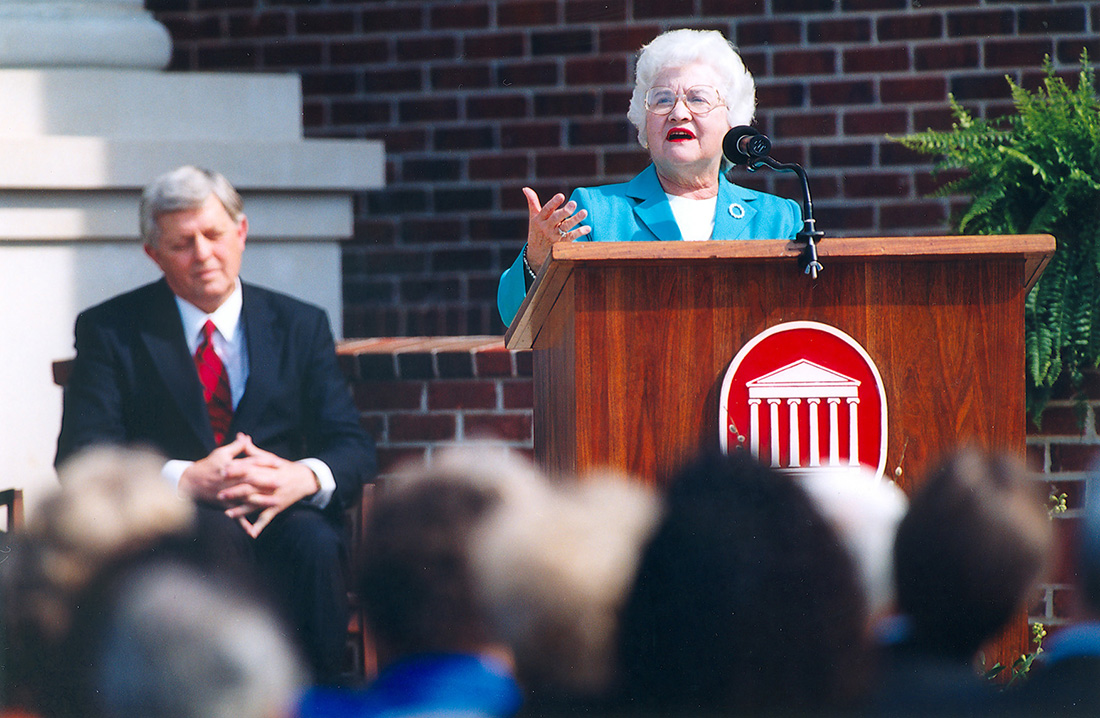
Dr. Phillips speaking at dedication of the new Institute building March 23, 2001. Chancellor Robert Khayat in background.
Dr. Jeanette Phillips
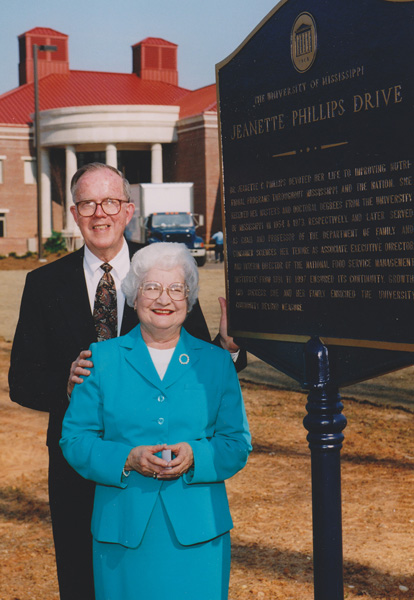
Dr. Phillips and her husband at the dedication of the new Institute building and of Jeanette Phillips Drive March 23, 2001. The historical marker reads: Dr. Jeanette C. Phillips devoted her life to improving nutritional programs throughout Mississippi and the Nation.
Dr. Jeanette Phillips passed away June 13, 2017. A memorial service was held Friday, June 16, 2017, at First Baptist Church, Oxford, MS.
Dr. Phillips was instrumental in the establishment of the Institute of Child Nutrition (originally the National Food Service Management Institute) at the University of Mississippi in 1989 and was the first Acting Executive Director who played a pivotal role in setting up the Institute in 1990-1991. She then served as Associate Executive Director and acting Director of Technology Transfer division. She again served as interim Executive Director from September 1, 1996, until June 30, 1997. During her tenure, Dr. Phillips played a fundamental role in planning for the construction of a permanent building for the Institute. The new building was dedicated on March 23, 2001, along with Jeanette Phillips Drive, a street on the University of Mississippi campus where the Institute is located. The street’s historical marker reads: Dr. Jeanette C. Phillips devoted her life to improving nutritional programs throughout Mississippi and the Nation.
She conducted the first BLT training on a national level at the American School Food Service Association (now the School Nutrition Association) Annual National Conference in July 1991, bringing the Institute to the national stage.
She was also an organizer and instructor in the Orientation to School Nutrition Management Seminar, which has been a signature training course for the Institute since 1994.
She was known for her quiet leadership and encouragement of students, faculty, and the staff of the Institute.
Prior to her work with the Institute, Dr. Phillips was a professor at the University of Mississippi and chair of the Department of Home Economics.
When she “retired” from the University December 31, 1997 after serving over 40 years, almost 300 guests attended her reception at the Triplett Alumni Center on the Oxford campus of the University. USDA Food and Nutrition Services (USDA FNS) was represented by Dorothy Caldwell, Special Assistant for Nutrition and Nutrition Education, who expressed her appreciation to Dr. Phillips for providing leadership to the Institute in a variety of capacities. Jim Reeves, Assistant Director for Administration, described Dr. Phillips’ long association with nutrition educators in Mississippi and her untiring efforts to start the Institute from “a clean sheet of paper.” Dr. Gerald Walton, Provost, presented the retiree with a wristwatch from The University staff council. NFSMI staff had solicited and compiled mementos from friends and colleagues into a memory book. The book was displayed at the reception and presented to Dr. Phillips at the conclusion of the event (NFSMI Update Vol. Three Number One. Spring 1998).
In June 2002, Dr. Jeanette Phillips again assumed the position of interim Executive Director where she served until June 30, 2003. She continued to serve the Institute as Associate Executive Director Emeritus.
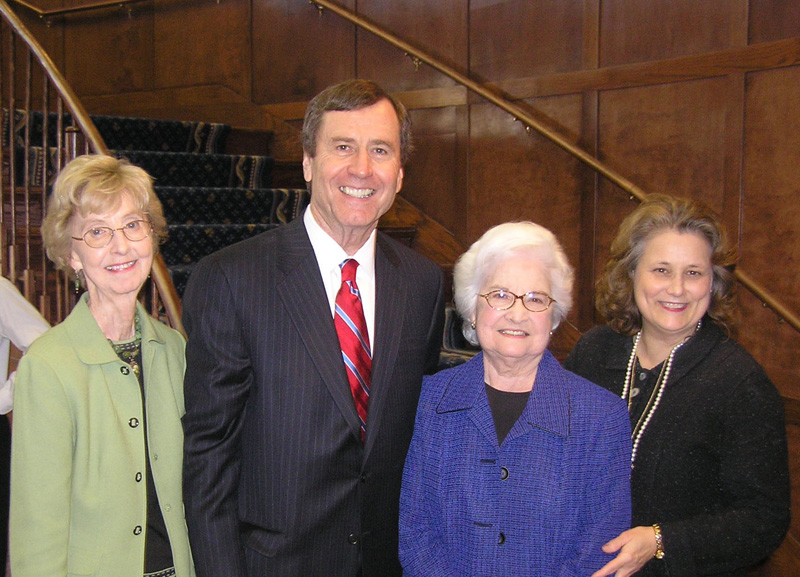
Dr. Phillips (2nd from right) with Dr. Martin, Dr. R. Gerald Turner (former Chancellor of UM), and Dr. Charlotte Oakley, former Executive Director of the Institute, at the dedication of the building as R. Gerald Turner Hall February 16, 2007.
During her tenure at Ole Miss she received a number of honors including Outstanding Teacher Award, The University of Mississippi; Outstanding Teacher Award, School of Education; Magnolia Award; Mississippi Dietetics Award for Outstanding Contribution to the Profession of Nutrition; Leston L. Love Award for Outstanding Service in the Area of Students; Teacher of the Year Award; and Mortar Board. She was also initiated into Omicron Delta Kappa, an honorary fraternity that recognizes the highest degree of service, leadership, and scholarship at the University.
Jeanette Collier Phillips, Ed.D., L.D., received her bachelor’s degree from Blue Mountain College, and her master’s degree and doctorate from the University of Mississippi. She was project director for the Nutrition Education Training Program for Mississippi from 1979-1989 through a grant from the Mississippi State Department of Education, and served as chair of the Home Economics Department at the University of Mississippi.
She was preceded in death by a son, Daniel Morris Phillips who died Dec. 12, 2005, at the University of Alabama-Birmingham Hospital; and her husband of 62 years Jesse Pittman Phillips, who died February 28, 2016. She is survived by two sons: Tim Phillips and Andy Phillips.
More Articles to Read:
Dr. Josephine Martin and Dr. Jeanette Phillips
In Memory of Jeanette Collier Phillips
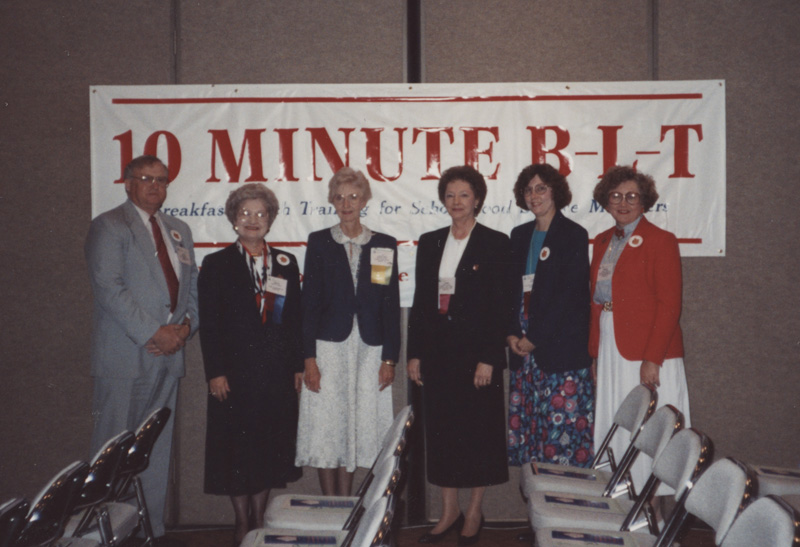
Institute staff Jim Reeves, Dr. Phillips, Dr. Martin, Dr. Hellums, Beth King, and Carolyn Hopkins at the ASFSA ANC in Las Vegas, July 1991.
Get Ready to Grill Safely – Institute of Child Nutrition
Get Ready to Grill Safely
Food poisoning peaks in the summer months when warmer temperatures cause foodborne germs to flourish. Follow these steps for a safe and enjoyable grilling season.
Separate:
When shopping, pick up meat, poultry, and seafood last, right before checkout. Separate them from other food in your shopping cart and grocery bags. To guard against cross-contamination, put packages of raw meat and poultry into individual plastic bags.
Chill:
Keep meat, poultry, and seafood refrigerated until ready to grill. When transporting, keep below 40°F in an insulated cooler.
Clean:
Wash your hands with soap before and after handling raw meat, poultry, and seafood. Wash work surfaces, utensils, and the grill before and after cooking.
Check your grill and tools:
Use a moist cloth or paper towel to clean the grill surface before cooking. If you use a wire bristle brush, thoroughly inspect the grill’s surface before cooking. Wire bristles from grill cleaning brushes may dislodge and stick into food on the grill.
Don’t cross-contaminate:
Throw out marinades and sauces that have touched raw meat juices, which can spread germs to cooked foods. Use clean utensils and a clean plate to remove cooked meat from the grill.
Cook:
Use a food thermometer to ensure meat is cooked hot enough to kill harmful germs. When smoking, keep temperatures inside the smoker at 225°F to 300°F to keep meat a safe temperature while it cooks.
- 145°F – whole cuts of beef, pork, lamb, and veal (stand-time of 3 minutes at this temperature)
- 145°F – fish
- 160°F – hamburgers and other ground beef
- 165°F – all poultry and pre-cooked meats, like hot dogs
Smoking:
- 250°F – 300°F – inside smoke
After Grilling:
- 140°F or warmer – until it’s served
Refrigerate:
Divide leftovers into small portions and place in covered, shallow containers. Put in freezer or fridge within two hours of cooking (one hour if above 90°F outside).